


Programming Note: The Book of Jobbed, a tongue-in-cheek newsletter about sports and existential angst, is now Typo Country, a tongue-in-cheek newsletter about American culture and existential angst. We begin our re-brand by writing about the topic most antithetical to sports—nerd shit.
Spider-Man: Brand New Day, the fourth Sony-Disney co-produced Spider-Man film starring Tom Holland, is a fun and surprisingly moving film about what loneliness does to young people. Naturally, it wants you to think it has something very important to say, but its thematic pretensions are undercut because it doesn’t want to talk about something rather important: Money.
The movie picks up where the last in the Sony-Disney series left off. Peter Parker’s identity as Spider-Man had been revealed to the world, but thanks to the magical power of corporate synergy, a superhero from another franchise cast a magic spell that’s made everyone remember Spider-Man, but forget Peter Parker ever existed. This includes his Peter’s best friend, Ned, and his love interest, MJ, leaving Peter well and truly alone in the world.
A leisurely paced opening montage depicts the next lonely four years of Peter’s life. He dutifully carries out his mission anonymously fighting crime as Spider-Man and strenuously avoids social interactions as Peter. He goes so far as to change apartments when an attractive blonde comes up to him and goes, “don’t we live on the same floor?” The closest thing to human connection he has is checking Instagram for updates on Ned and MJ’s lives. The extended social isolation causes glitches in his spider-themed superpowers just as an unidentified telepath emerges as a threat. Action-adventure set pieces ensue. It turns out the telepath is Peter’s Jungian shadow, a young woman who is socially isolated but uses her ability to do social harm rather than social good. More action-adventure set pieces ensue. Bing, pang, pow.
An obvious question emerges as the movie sets up its status quo, though. How does Peter afford his rent, groceries, and all the sleek, high-tech, and very expensive looking gadgets and gizmos? He doesn’t steal. He doesn’t have a job. He doesn’t busk. The movie never offers an explanation.
I point it out not to fault it as a plot hole, but because it’s very, very conspicuous. Money, or the lack thereof, is foundational to Peter Parker’s identity as a character.
Traditionally, he is an explicitly working-class young man striving to move up the social ladder to middle-class. He splits his time between being a college student and a superhero, managing his bills by selling photos of his Spider-Man’s crime fighting exploits to a newspaper editor who pays him peanuts and insults him to his face. It’s freelance work. No benefits.
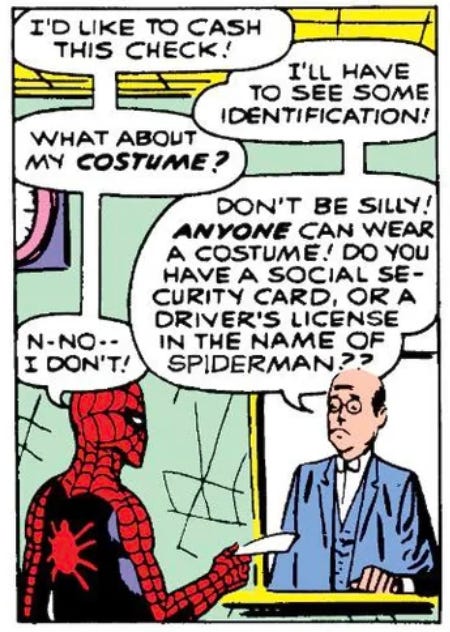
Even if he wanted to get paid for his hero work, he can’t. In one of the earliest comics, a civilian cuts Spider-Man a check as thanks for his help, but the bank won’t honor it because “Spider-Man” doesn’t have a social security card or driver’s license.
Money problems as a plot element isn’t something that was dropped by contemporary iterations of the character. The Sami Rami directed films of the early-to-late oughts explicitly show Peter struggling to pay rent. The two Marc Webb directed films in the late Obama-era sidestep giving its protagonist financial problems by having the 30-year-old Andrew Garfield play a teenaged Peter, but Sally Field and Martin Sheen’s Aunt May and Uncle Ben are nevertheless explicitly coded as working-class boomers. The 2018 and 2023 video game iterations of Peter Parker both use economic anxiety as characterization. In the first game, Peter hasn’t gotten paid by his employer in some time, and is eventually evicted from an apartment and has to couch surf for the rest of the story. In the sequel, he’s living in the childhood home he inherited after his aunt’s death, but fears he will lose it because he cannot afford the mortgage.
But in the Disney-Sony co-productions, Peter has no class identity at all. He never worries about money. He starts the series at an elite high school on track to attend an elite university. His surrogate parents are minimally characterized; Aunt May is some sort of nonprofit knowledge worker and his uncle’s death happens off-screen with the circumstances never described. His superhero mentor is the billionaire nepobaby Tony Stark. No class friction ever materializes between them, with the conflict points being primarily generational. Perhaps Tony left him an inheritance upon his death in The Avengers’ finale, and while everyone has forgotten who Peter Parker is, the bank remembers the total in his account.
“Get to the point, Dan,” every reader is probably saying, their cursors gradually trending toward the X-button. “This all sounds like comic book nerd it-sucks-because-they-changed-it bullshit. Why do you care? Why would anybody who doesn’t live in their mom’s basement playing Marvel Rivals all day care? You even admitted it was a good movie in the lede of this post. Is it because you live in your mom’s basement playing Marvel Rivals all day?”
To which I say, no. I do not live my mother’s basement and I do not even know what Marvel Rivals is.
I care because the way American culture thinks and talks about loneliness is absolute nonsense. Should you ask the opinion board of any national paper, a number of academics, the comment sections of any pseudo-intellectual Instagram or TikTok account, loneliness is a white male experience, even though study after study show rates of loneliness are generally equal when you control for race and gender. The arguments with then pivot to technology, echoing the thesis of the wildly overrated Bowling Alone that we make the choice to spend too much time on our phones/TVs/computers, imagery which Brand New Day is happy to invoke.
But it is, again, bullshit. The best predictor of loneliness is not your race, your gender, or how much time you spend on your phone. It is how much money you have. If you’re poor, you’re fucked.
As it’s put in the first good article posted on Slate in at least ten years, “America’s Loneliness Trap” by Nick Keppler:
According to the KFF study, adults in households making less than $40,000 in annual income are about three times as likely to report frequent loneliness as those in households making more than $90,000. In the Harvard survey, 29 percent of those earning less than $30,000 felt lonely, compared to 19 percent of those earning $50,000 and up. In the American Perspectives Survey, 1 in 5 U.S. adults without a college education said they had no close friends—about double the rate of those with at least a bachelor’s. In the American Time Use Survey, people making $25,000 a year or less spent almost six and a half hours alone in an average day, about 90 minutes more than those in the $25,000-to-$50,000 bracket and three hours more than those making $100,000 or more. The poorest group also had the sharpest increase since 2010, when they spent about four hours alone each day.
But Americans do not like talking about income and income inequality. Income, so it goes in the popular imagination, is downstream of personal choices and a natural, meritocratic sorting of the good and hardworking from the less good and less hardworking. Egalitarianism is anathema to the American worldview. The field of psychology, meanwhile, barely approaches the topic of how economics affects our minds. A review of social psychology literature found that, over the last three decades, only 24 journal articles explicitly included the term “capitalism” in their title, abstract, or keywords.
Perhaps it will strike some as silly to criticize blockbuster entertainment for not participating in this conversation, that it is too much to think that a film like this could acknowledge, even implicitly, the way our income impacts us, but as demonstrated earlier, it’s not as if this particular character and media property hasn’t grappled with the idea before.
It’s not hard to imagine what caused the change. Tempting as it is to say that the extremely well-paid creatives and executives steering the movie’s narrative are simply out of touch and feel like money woes are an unnecessary downer in blockbuster entertainment, and that very well could have driven the change, there’s an equally plausible and simpler explanation. Peter is a computer wiz. A computer wiz could pick up well paying work on the side. It’s not particularly cinematic so, by the laws of good storytelling, we’ll omit this detail from the picture. That’s a perfectly reasonable, if disappointing, creative choice.
Whatever the case, Brand New Day was a very well executed movie I enjoyed very much, but the omission of class awareness is glaring and hangs over the proceedings awkwardly, like a spider on the interior hood of a moving car. It could’ve been more than a good time at the movies, but it never reaches those heights, as much as it cannot help but grasp at its ridge.